Buying a corrosion test chamber is a significant investment, and selecting the correct model involves considerably more than simply choosing a chamber capacity.
The right equipment should perform the test standards you require today while also giving your laboratory enough flexibility to support future testing programmes.
Before purchasing a salt spray or cyclic corrosion test chamber, there are several important factors laboratories should consider.
1. Start with your test standards
The most important question is not:
“What chamber size do we need?”
It is:
“What test standards do we need to perform?”
Different corrosion test methods require different environmental conditions.
Traditional salt spray standards may require continuous salt fog at controlled temperature, while advanced automotive corrosion standards can involve complex combinations of:
- Salt spray
- Controlled humidity
- Condensation humidity
- Drying
- Temperature changes
- Refrigerated conditions
Examples of commonly requested corrosion testing standards include ASTM B117, ISO 9227, VDA 233-102, PV1209, ISO 11997-1 and various manufacturer-specific automotive standards.
A chamber should therefore be selected around the full environmental requirements of the test method.
For a comprehensive list of available test standards – visit our test standard matrix for test standards vs chamber requirements
2. Salt spray or cyclic corrosion?
Not every laboratory requires a fully programmable cyclic corrosion chamber.
If your testing is limited to conventional neutral salt spray methods such as ASTM B117 or ISO 9227 NSS, a dedicated salt spray chamber may provide everything you need.
However, laboratories working with automotive, aerospace, defence or advanced coatings applications may require cyclic testing.
A cyclic corrosion chamber can automatically move between multiple environmental stages, such as:
Salt spray → humidity → drying → controlled temperature → repeat
Understanding this distinction early prevents laboratories from either purchasing equipment they do not need or selecting a chamber that cannot support future test programmes.
3. Consider your sample dimensions — not just chamber volume
Chambers are often described by their internal litre capacity, but volume alone does not tell you whether your samples will fit.
The physical dimensions of your largest test specimen are equally important.
Before requesting a quotation, record:
- Maximum specimen length
- Maximum specimen width
- Maximum specimen height
- Number of specimens tested simultaneously
- Required mounting angle
- Required spacing between specimens
Large components may need a substantially larger chamber even when the overall test quantity is relatively small.
4. Think about specimen loading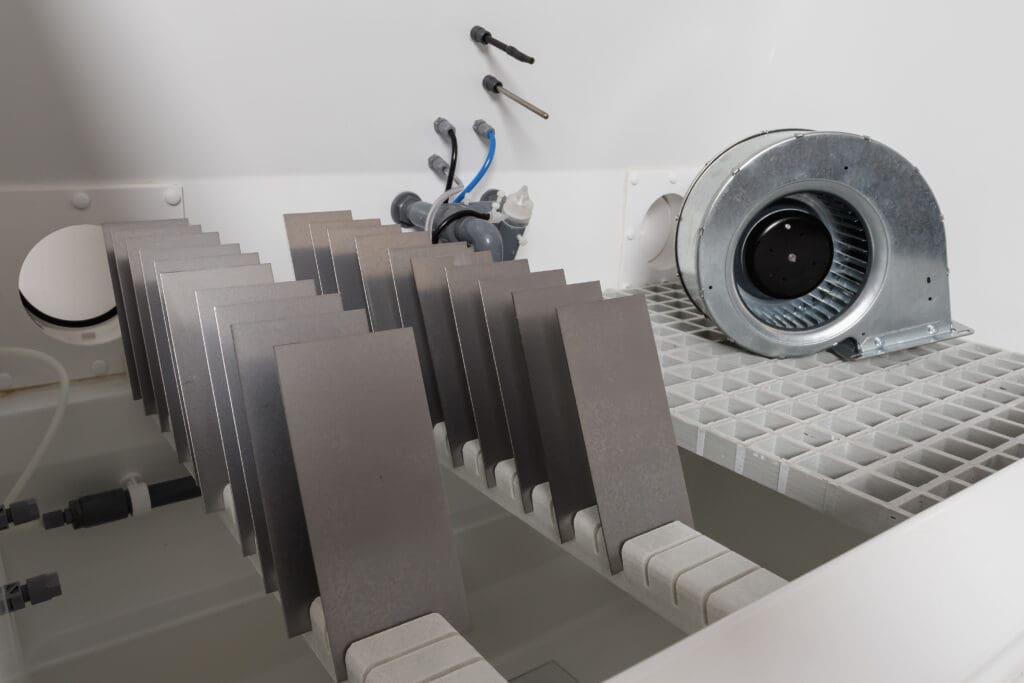
Test samples must be positioned correctly within the chamber.
Overloading or incorrectly positioning specimens can affect salt fog distribution and may compromise the integrity of the test.
Consider how samples will be supported and whether specialised racks, hanging bars or specimen holders will be required.
For laboratories testing standard coated panels, relatively simple racks may be suitable.
For automotive components, assemblies or irregularly shaped products, custom specimen support may be required.
5. Check temperature requirements carefully
Temperature capability is particularly important when comparing cyclic corrosion chambers.
Two chambers that initially appear similar may have very different operating ranges.
Some test standards require elevated temperatures only, while others require sub-zero conditions.
Automotive corrosion programmes may include temperatures significantly below freezing.
If your required standard includes refrigerated stages, make sure the complete test sequence falls within the operating capability of the chamber being considered.
The quoted chamber should be technically compliant with the whole test method — not simply capable of performing some of the individual stages.
6. Check humidity control
Humidity capability is another area where corrosion chambers can differ considerably.
A basic salt spray chamber may not provide controlled relative humidity.
More advanced cyclic corrosion chambers may offer:
- Controlled relative humidity
- Condensation humidity
- Saturated humidity
- Ambient drying
- Forced-air drying
If your required standard specifies a particular humidity range, confirm that the chamber can actively control those conditions throughout the required temperature range.
7. Look at the complete test cycle
When reviewing a cyclic corrosion requirement, avoid checking individual conditions in isolation.
Instead, examine the complete sequence.
For example, a chamber may be able to reach the required temperature and separately achieve the required humidity but may not be capable of maintaining both conditions simultaneously.
The complete cycle should therefore be reviewed stage by stage.
Ascott regularly reviews customer test standards before quoting equipment for this reason.
8. Consider future test requirements
Corrosion chambers are typically long-term capital investments.
A laboratory purchasing a chamber today may be asked to perform new customer standards several years later.
Where practical, buyers should therefore consider future flexibility.
Questions worth asking include:
- Are customers moving towards cyclic corrosion testing?
- Could refrigerated testing be required later?
- Will controlled humidity become necessary?
- Is additional chamber capacity likely to be needed?
- Could larger components be introduced?
Selecting equipment with some additional capability can sometimes avoid the need for another major capital investment later.
9. Evaluate usability and maintenance
Testing capability is important, but so is day-to-day operation.
Operators should consider:
- User interface
- Programme creation
- Test data recording
- Salt solution access
- Chamber cleaning
- Routine maintenance
- Access to service components
- Spare parts availability
Corrosion testing creates an aggressive environment, making equipment construction and maintenance particularly important.
The test chamber should be designed around long-term exposure to salt and humidity rather than simply adapting general laboratory equipment for corrosive use.
10. Consider lifetime support
A corrosion chamber may remain in service for many years.
Before purchasing, consider the support available from the equipment manufacturer.
This may include:
- Installation
- Operator training
- Calibration
- Preventative maintenance
- Technical support
- Spare parts
- Software support
- Test standard advice
Buying purely on initial purchase price can become expensive if technical support or replacement components are difficult to obtain later.
11. Compare equipment on a like-for-like basis
Price comparisons between corrosion chambers can sometimes be misleading.
Two models may have similar chamber capacities but very different environmental capabilities.
When comparing quotations, check:
- Temperature range
- Humidity range
- Refrigeration
- Drying capability
- Salt spray capability
- Required accessories
- Control system
- Included specimen supports
- Installation requirements
- Warranty
- Service support
A lower-cost chamber is not necessarily equivalent if additional equipment or accessories are required to perform the specified test method.
12. Ask the manufacturer to review your test standard
One of the simplest ways to reduce specification risk is to provide the chamber manufacturer with the exact test standard before ordering.
Rather than asking for a generic “salt spray chamber”, send the test specification and ask the manufacturer to confirm compliance.
This allows any additional requirements to be identified before the equipment is ordered.
Choosing the right Ascott chamber
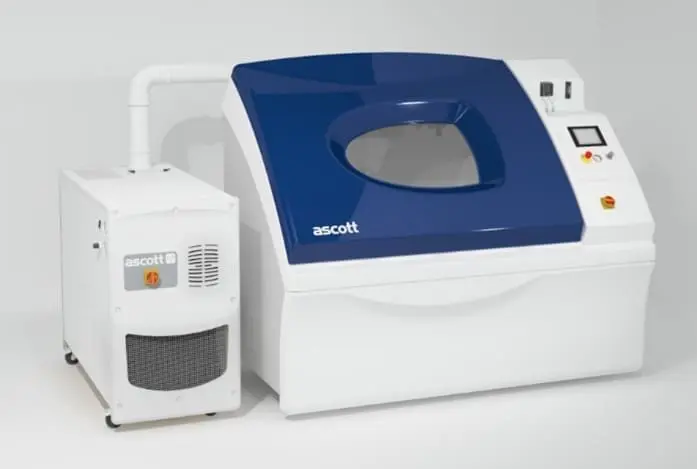
Ascott manufactures corrosion test equipment ranging from compact salt spray systems to advanced cyclic corrosion chambers with controlled humidity, drying and refrigeration.
Our equipment supports test programmes used throughout automotive, aerospace, defence, electronics, coatings, marine and general manufacturing industries.
If you provide us with your required test standard, specimen dimensions and expected test quantity, we can recommend an appropriate chamber configuration.
Need help specifying your corrosion testing equipment?
Choosing the right corrosion chamber at the beginning of a project can prevent costly changes later.
Send Ascott your test standard and specimen dimensions and our technical sales team can recommend the most suitable salt spray or cyclic corrosion chamber for your application.