Salt spray testing has been used by manufacturers for decades to evaluate the corrosion resistance of materials, coatings and components.
Today, however, many industries also use cyclic corrosion testing, where specimens are exposed to a sequence of changing environmental conditions.
So what is the difference between salt spray and cyclic corrosion testing — and when should each method be used?
What is salt spray testing?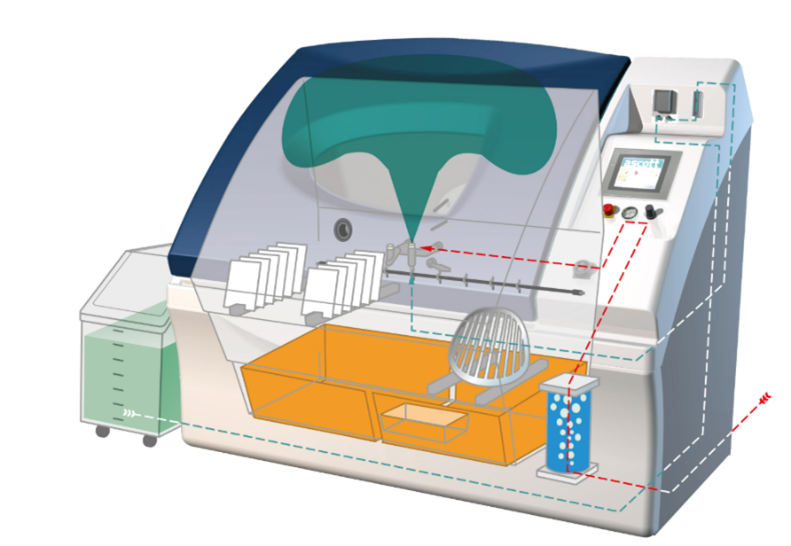
Salt spray testing exposes samples to a continuous corrosive salt fog inside a controlled test chamber.
Two of the best-known standards are ASTM B117 and ISO 9227, which are widely used throughout automotive, aerospace, coatings, metal finishing and general manufacturing industries.
During testing, a saline solution is atomised inside the chamber to create a consistent salt fog.
Test specimens remain exposed for a defined period before being inspected for signs of corrosion, coating failure or other changes.
Salt spray testing is commonly used for:
- Comparative coating evaluation
- Quality control
- Process verification
- Supplier approval
- Product development
- Compliance with customer specifications
Its strength lies in providing a highly repeatable and internationally recognised test environment.
What is cyclic corrosion testing?
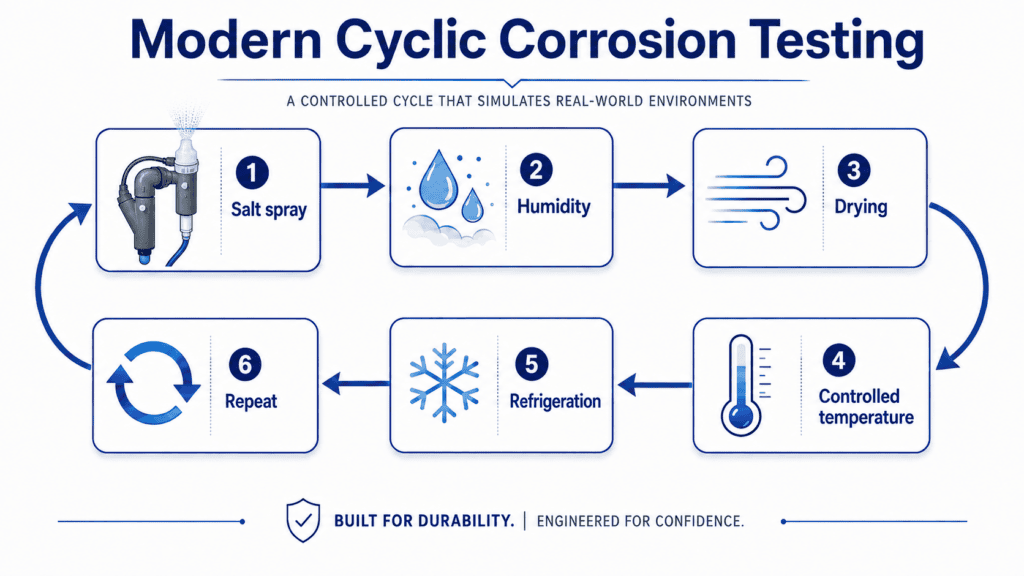
Cyclic corrosion testing, often abbreviated to CCT, subjects samples to a sequence of changing environmental conditions.
Rather than maintaining continuous salt fog, a cyclic corrosion chamber may repeatedly move through stages including:
Salt spray → high humidity → drying → temperature control → refrigeration → repeat
Depending on the test standard, cycles may also include condensation humidity, controlled relative humidity or refrigerated stages.
The sequence can then be repeated automatically over many hours or days.
Why use changing environments?
Real-world corrosion rarely occurs under one constant condition.
A vehicle component, for example, may be exposed to road salt before becoming wet, drying, cooling overnight and becoming humid again.
Similarly, marine or industrial components may experience alternating periods of salt contamination, moisture, temperature change and drying.
Cyclic corrosion tests attempt to reproduce some of these changing environmental stresses within a controlled laboratory programme.
This does not mean that cyclic testing should automatically replace traditional salt spray testing.
The correct test method should always be determined by the relevant standard, customer specification or validation programme.
Is cyclic corrosion testing more realistic than salt spray?
Cyclic corrosion tests are often developed with the intention of reproducing more complex environmental conditions than continuous salt fog.
By combining multiple climates, engineers can observe corrosion mechanisms that may not develop in exactly the same way under a constant salt spray environment.
However, laboratory corrosion testing should not normally be interpreted as a simple conversion between test hours and years of real-world life.
For example, 1,000 hours of salt spray does not automatically represent a fixed number of years in service.
Corrosion behaviour depends on factors including:
- Material
- Coating type
- Coating thickness
- Component geometry
- Temperature
- Humidity
- Salt concentration
- Wet and dry periods
- Real-world operating environment
Accelerated corrosion testing is therefore generally most useful as a comparative and validation tool when performed using a defined test method.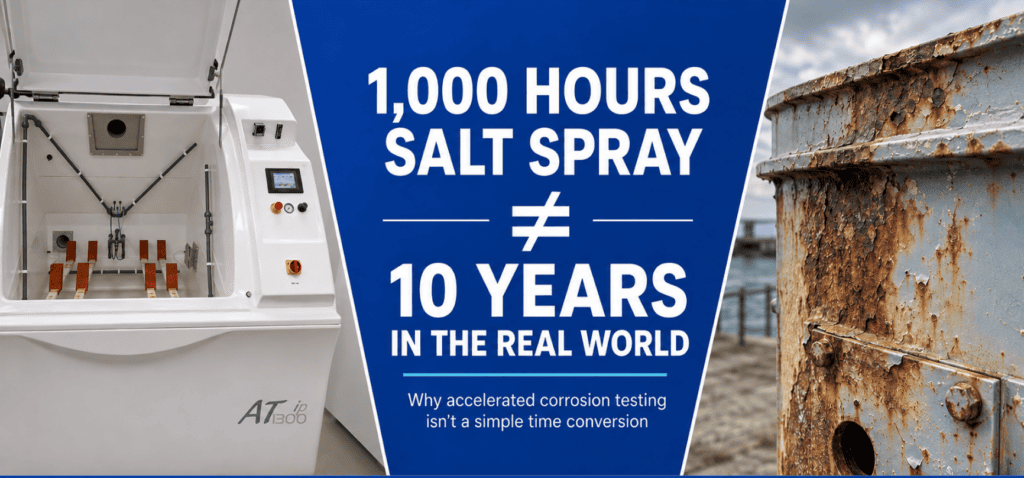
Where is cyclic corrosion testing commonly used?
Cyclic corrosion testing is particularly important in sectors where components face complex environmental exposure.
These include:
Automotive
Automotive manufacturers increasingly specify cyclic corrosion standards that combine salt, humidity, drying and temperature stages.
Aerospace and defence
Components may experience extreme changes in temperature, moisture and saline contamination during service.
Coatings and paint
Coating manufacturers use corrosion testing to compare formulations and evaluate protective performance.
Marine
Marine components experience repeated wetting, salt deposition and drying.
Electronics
Enclosures, connectors and components may require evaluation against combinations of humidity and corrosive contaminants.
Salt spray or cyclic corrosion: which do you need?
The simplest answer is: follow the required test standard.
If your specification calls for ASTM B117 or ISO 9227 neutral salt spray, you need a chamber capable of performing those conditions accurately and repeatably.
If your requirement includes programmed humidity, drying or changing temperatures, a cyclic corrosion chamber may be required.
It is also important to consider future requirements.
A laboratory purchasing equipment solely around today’s test programme may later be asked to perform more advanced customer-specific cyclic tests.
For this reason, organisations should consider both current and anticipated testing requirements when selecting corrosion equipment.
please use our handy test chamber configurator to help you select the correct test standard vs chamber requirement
Choosing the right corrosion chamber
Before specifying a chamber, laboratories should identify:
- Required test standards
- Specimen dimensions
- Number of samples
- Required chamber capacity
- Temperature range
- Humidity requirements
- Drying requirements
- Refrigeration requirements
- Future test programmes
Ascott manufactures a range of salt spray, premium salt spray and cyclic corrosion chambers designed for applications ranging from straightforward continuous salt fog through to advanced multi-stage testing.
Need help identifying the correct test chamber?
If you know the corrosion test standard you need to perform but are unsure which equipment configuration is required, Ascott can review the test method and recommend an appropriate chamber.
Contact Ascott Analytical with your test standard or customer specification and our team can help identify the most suitable corrosion testing solution.